













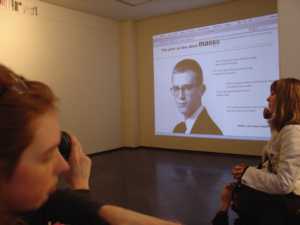
| THIS IS MAHKU |
| MaHKU is the working title for the master programmes of the Utrecht Graduate School of Visual Art and Design. Since 2004 we offer an ever widening range of master programmes. The Utrecht Graduate School of Visual Art and Design is embedded in the Faculty of Visual Arts and Design of HKU, the Utrecht School of the Arts, the largest art school in the Netherlands. HKU has been accredited by the Open University in London. Successful completion of its programmes leads to the internationally acknowledged title of 'master of arts (MA)'. THE 'WHY' OF OUR MASTER PROGRAMME Roughly speaking, bachelor programmes in art education focus on the "how" of creating art. You are trained in various technical aspects and skills of disciplines such as editorial design, fashion, painting, photography, urban interior, and so on. These are all complete programmes preparing you for practicing a clear-cut profession. But having acquired professional skills in the bachelor program, the question of the "why" of creating art indeed often emerges. MaHKU's master programmes meet the need of exploring that question. The focus is on critical reflection. You are invited to reflect theoretically on the horizons of your profession. Key notions such as research, communication, and cross-overs are at the core of our programmes. THE 'HOW" OF OUR MASTER PROGRAMME MaHKU initially offers a collective programme to all students. This programme takes place in the course Critical Studies. In this course the role of research as an activity, which inspires and permeates both practice and theory of art and design, the boundaries of media and disciplines, and the possibilities of cross-overs will come to the fore. This course parallels the course Discipline Related Reflection, so that reflection on similarities and interactions continuously feeds back to the discipline practice. As a consequence, the MaHKU programmes focus at a fruitful interaction between discipline-specific topics and discussions, and broad theoretical questions from the field of critical studies. Such an approach is expected to create a flexible research attitude, where you are able to cross boundaries from your specific design discipline or medium to other professional and theoretical fields while dynamizing your own professional domain. |

